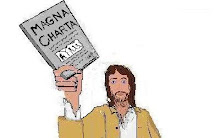
Here's Judge Napolitano discussing day 3 of the Supreme Court hearing into Obamacare. Although there's plenty of time to wait for the ruling, it seems like Obama's unconstitutional dragon may have met its St. George.
Showing posts with label Constitution. Show all posts
Showing posts with label Constitution. Show all posts
Saturday, 31 March 2012


Tuesday, 29 November 2011
USA: Requiem for a free country
From Business Insider:
Either Monday or Tuesday the Senate will vote on a bill that allows the US military to imprison civilians with no formal charges and hold them with no trial.The ACLU reports even US citizens wouldn't be immune as the legislation aims to declare national territory part of the "battlefield" in the War on Terror.
Termed the National Defense Authorization Act (NDAA) and drafted behind closed doors by Senators Carl Levin (D-Mich.) and John McCain (R-Ariz.) the NDAA would:
1) Explicitly authorize the federal government to indefinitely imprison without charge or trial American citizens and others picked up inside and outside the United States;
(2) Mandate military detention of some civilians who would otherwise be outside of military control, including civilians picked up within the United States itself; and
(3) Transfer to the Department of Defense core prosecutorial, investigative, law enforcement, penal, and custodial authority and responsibility now held by the Department of Justice.
Saturday, 8 May 2010
A wasted voter speaks
With all this debate about our electoral system, the one question I'm sure has been resonating up and down the nation is: 'what does the Trooper say?' Well, my dear people...
It is important to remember why we have a 'first past the post' (FPTP) system. It was not designed to be unfair, but has become so, because of the rise of party politics. It is the predominance of party politics that has undermined the concept of selecting the best individual from a particular place, because MPs no longer represent their constituents, but rather follow a party line. Sure, there are still a handful of 'mavericks', and others will occasionally go against the whip if the question concerns a factory in their own backyard shutting down or some such event, or if the issue is of such controversy that they manage to locate their cojones, but if they know what's good for their career, they'll do what they're told.
Some people want to keep alive the old principle of constituency MPs, but it's largely gone. The local branches of the political parties have very little power. When an MP decides to stand down, they will often do so at the last minute, to allow Central Office to parachute one of their pals into a safe seat. We cannot expect the electoral system to compensate for the lack of local democracy in the political parties, and no party is going to surrender its prerogative powers over local branches.
If the aim is to make the House of Commons the most representative of the people of this country, then the best system would be based on party lists, so instead of an individual, you vote for a party. This would be resisted by those who value the access to an MP which is afforded by their role as representative of a particular constituency, but there would be nothing to stop political parties running local 'surgeries' as MPs currently do, and/or nominating particular MPs to cover particular geographic areas. Personally, the loss of a local representative would bother me not at all. My MP does not represent me in any way, and my constituency has no particular identity, it was just drawn on a map.
The trouble with any kind of reform is that it will be done by the main political parties, who will each want to ensure the best deal for themselves. Turkeys rarely vote for Christmas, and they will not want to put in place a system that favours the rise of new political forces. It's far more likely that they will use voter dissatisfaction as a pretext to destroy what's left of the House of Lords, whilst further entrenching themselves in the Commons.
It is important to remember why we have a 'first past the post' (FPTP) system. It was not designed to be unfair, but has become so, because of the rise of party politics. It is the predominance of party politics that has undermined the concept of selecting the best individual from a particular place, because MPs no longer represent their constituents, but rather follow a party line. Sure, there are still a handful of 'mavericks', and others will occasionally go against the whip if the question concerns a factory in their own backyard shutting down or some such event, or if the issue is of such controversy that they manage to locate their cojones, but if they know what's good for their career, they'll do what they're told.
Some people want to keep alive the old principle of constituency MPs, but it's largely gone. The local branches of the political parties have very little power. When an MP decides to stand down, they will often do so at the last minute, to allow Central Office to parachute one of their pals into a safe seat. We cannot expect the electoral system to compensate for the lack of local democracy in the political parties, and no party is going to surrender its prerogative powers over local branches.
If the aim is to make the House of Commons the most representative of the people of this country, then the best system would be based on party lists, so instead of an individual, you vote for a party. This would be resisted by those who value the access to an MP which is afforded by their role as representative of a particular constituency, but there would be nothing to stop political parties running local 'surgeries' as MPs currently do, and/or nominating particular MPs to cover particular geographic areas. Personally, the loss of a local representative would bother me not at all. My MP does not represent me in any way, and my constituency has no particular identity, it was just drawn on a map.
The trouble with any kind of reform is that it will be done by the main political parties, who will each want to ensure the best deal for themselves. Turkeys rarely vote for Christmas, and they will not want to put in place a system that favours the rise of new political forces. It's far more likely that they will use voter dissatisfaction as a pretext to destroy what's left of the House of Lords, whilst further entrenching themselves in the Commons.
Thursday, 25 March 2010
Tuesday, 19 January 2010
Polybius on government
 In connection to the post below on democracy, here is a classical view of the different forms of government, taken from Polybius:
'Most of those whose object it has been to instruct us methodically concerning such matters, distinguish three kinds of constitutions, which they call kingship, aristocracy, and democracy. Now we should, I think, be quite justified in asking them to enlighten us as to whether they represent these three to be the sole varieties or rather to be the best; for in either case my opinion is that they are wrong. For it is evident that we must regard as the best constitution a combination of all these three varieties, since we have had proof of this not only theoretically but by actual experience, Lycurgus having been the first to draw up a constitution — that of Sparta — on this principle.
Nor on the other hand can we admit that these are the only three varieties; for we have witnessed monarchical and tyrannical governments, which while they differ very widely from kingship, yet bear a certain resemblance to it, this being the reason why monarchs in general falsely assume and use, as far as they can, the regal title. There have also been several oligarchical constitutions which seem to bear some likeness to aristocratic ones, though the divergence is, generally, as wide as possible. The same holds good about democracies. The truth of what I say is evident from the following considerations. It is by no means every monarchy which we can call straight off a kingship, but only that which is voluntarily accepted by the subjects and where they are governed rather by an appeal to their reason than by fear and force. Nor again can we style every oligarchy an aristocracy, but only that where the government is in the hands of a selected body of the justest and wisest men. Similarly that is no true democracy in which the whole crowd of citizens is free to do whatever they wish or purpose, but when, in a community where it is traditional and customary to reverence the gods, to honour our parents, to respect our elders, and to obey the laws, the will of the greater number prevails, this is to be called a democracy.
We should therefore assert that there are six kinds of governments, the three above mentioned which are in everyone's mouth and the three which are naturally allied to them, I mean monarchy, oligarchy, and mob-rule. Now the first of these to come into being is monarchy, its growth being natural and unaided; and next arises kingship derived from monarchy by the aid of art and by the correction of defects. Monarchy first changes into its vicious allied form, tyranny; and next, the abolishment of both gives birth to aristocracy. Aristocracy by its very nature degenerates into oligarchy; and when the commons inflamed by anger take vengeance on this government for its unjust rule, democracy comes into being; and in due course the licence and lawlessness of this form of government produces mob-rule to complete the series. The truth of what I have just said will be quite clear to anyone who pays due attention to such beginnings, origins, and changes as are in each case natural. For he alone who has seen how each form naturally arises and develops, will be able to see when, how, and where the growth, perfection, change, and end of each are likely to occur again. And it is to the Roman constitution above all that this method, I think, may be successfully applied, since from the outset its formation and growth have been due to natural causes.'
Polybius: Histories, Book VI
Monday, 18 January 2010
Is this democracy?
 DK is having one of his periodic pops at democracy, which is all very well, if for no other reason than to turn attention on a very important political concept, and one for which the coinage has
  been greatly debased. DK's criticisms are mostly correct, as far as they go. Democracy has certain flaws, which are worth being reminded of, if only to draw attention to what the word actually means, being so over-used and vaguely defined. But DK seems to be attacking, not democracy, but our present political system, which I think is inaccurately defined as such, for reasons I will expand upon.
Regarding the abuse of language, common in politics, Orwell writes:
'The word Fascism has now no meaning except in so far as it signifies "something not desirable." The words democracy, socialism, freedom, patriotic, realistic, justice have each of them several different meanings which cannot be reconciled with one another. In the case of a word like democracy, not only is there no agreed definition, but the attempt to make one is resisted from all sides. It is almost universally felt that when we call a country democratic we are praising it: consequently the defenders of every kind of regime claim that it is a democracy, and fear that they might have to stop using that word if it were tied down to any one meaning. Words of this kind are often used in a consciously dishonest way. That is, the person who uses them has his own private definition, but allows his hearer to think he means something quite different.'
From the essay 'Politics and the English Language'
I am not suggesting DK is employing this latter technique, but it seems the case that a debate on the subject in hand will involve sometimes as many definitions as participants. Insofar as DK wishes to attack our present political system, I will generally agree, but not when he attributes it to a surfeit of democracy.
My contribution to the comment thread was as follows:
"Most modern politicians have studied politics as an academic subject, and thus will know that ours is not a democratic system, but rather a mixed system, such as the constitution of the Roman Republic or Sparta, which combines elements of monarchy, aristocracy and democracy. This is seen by classical writers such as Polybius and Livy as the best form of government, as the different elements hold in check the others from lapsing into their Mr Hyde alter-egos, being tyranny, oligarchy and mob rule. In our case, the system seems to be breaking down, but I don't think this can be attributed solely to the democratic element mis-functioning."
My reliance on classical writers (see above) is mocked by one Ed Rose, evidently some kind of savant, who tells me that "just because classical writers wrote something, doesn't make it true." He also finds fault with my assertion that our political system is a blend of monarchy, aristocracy and democracy rather than a straight democracy. This seems obvious to me. Our Head of State is an hereditary monarch. We have a bi-cameral Parliament, the more powerful of which, the Commons, is democratically elected, the lesser, the Lords, traditionally a bastion of the aristocracy. This latter is no longer the case, as the hereditary peers have been mostly driven out and replaced by appointees from the political class that dominates the Commons. This could be seen as the democratic element usurping the aristocratic, thus throwing off the checks and balances of the mixed constitution advocated by Polybius, and if we view our Monarch as a powerless rubber stamp for whatever the current government desires, DK's description of our present system would seem to stand.
However, I don't think this really is the case. Our present system does not resemble mob rule. Our nation is one of the most ordered in the world. Our governments are amongst the most stable. The present government probably enjoys the support of 15 to 20% of the population, and much of that grudging. No doubt the government can be assured of widespread passivity. But this is borne not only from a lack of interest or concern, but also a sense of alienation in the people, who disbelieve that change is possible through the so-called democratic system, and as the expenses scandal illustrated, the people view the politicians as cut off from us, out of our reach, almost untouchable.
So, what of the aristocracy? Certainly in terms of the hereditary peers, we can see a diminution of their political clout. But although this bloc has receded, we are not short of individuals and entities that wield power out of proportion to their size, and enjoy the licence once enjoyed by the nobility. By strict definition, aristocracy is government by the best. Oligarchy, it's degenerate alter-ego, is government by the few. The former, I have no doubt, has fled the field, but the latter I see everywhere.
This is getting over-long, so I'll cut to the chase. The main problem with our political system is not that democracy has got out of hand, but rather that the political class has slipped its democratic anchor, corporations and financial institutions now stand in place of the aristocracy, and the monarchy has transformed into on one hand a tabloid soap story and on the other a secretive and autocratic executive. The checks and balances of our mixed constitution are being removed, and power is thus fusing into one, Borg-like entity. Not democracy, but crypocratic oligarchy.
Subscribe to:
Posts (Atom)