Sunday, 17 June 2012


Tuesday, 22 May 2012
RIchard Overton on Natural Rights
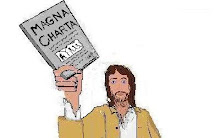
I've been doing a bit of reading from the great libertarians of the English Civil War period, one of which being Richard Overton, who laid out very clearly (at least as clear as 17th century English is to the modern reader) the principle of self-ownership, later developed by John Locke and other notables, e.g. Mr Jefferson, and the limits on state power. This was written during his illegal captivity by order of the House of Lords in 1646.
Wherein the original, rise, extent, and end of magisterial power, the natural and national rights, freedoms and properties of mankind are discovered and undeniably maintained;
the late oppressions and encroachments of the Lords over the commons legally (by the fundamental laws and statutes of this realm, as also by a memorable extract out of the records of the Tower of London) condemned;
the late Presbyterian ordinance (invented and contrived by the diviners, and by the motion of Mr Bacon and Mr Tate read in the House of Commons) examined, refuted, and exploded, as most inhumane, tyrannical and barbarous
Printed at the backside of the Cyclopian Mountains, by Martin Claw-Clergy, printer to the reverend Assembly of Divines, and are to be sold at the sign of the Subject's Liberty, right opposite to Persecuting Court. 1646
Sir,
To every individual in nature is given an individual property by nature not to be invaded or usurped by any. For every one, as he is himself, so he has a self-propriety, else could he not be himself; and of this no second may presume to deprive any of without manifest violation and affront to the very principles of nature and of the rules of equity and justice between man and man. Mine and thine cannot be, except this be. No man has power over my rights and liberties, and I over no man's. I may be but an individual, enjoy my self and my self-propriety and may right myself no more than my self, or presume any further; if I do, I am an encroacher and an invader upon another man's right — to which I have no right. For by natural birth all men are equally and alike born to like propriety, liberty and freedom; and as we are delivered of God by the hand of nature into this world, every one with a natural, innate freedom and propriety — as it were writ in the table of every man's heart, never to be obliterated — even so are we to live, everyone equally and alike to enjoy his birthright and privilege; even all whereof God by nature has made him free.
And this by nature everyone's desire aims at and requires; for no man naturally would be befooled of his liberty by his neighbour's craft or enslaved by his neighbour's might. For it is nature's instinct to preserve itself from all things hurtful and obnoxious; and this in nature is granted of all to be most reasonable, equal and just: not to be rooted out of the kind, even of equal duration with the creature. And from this fountain or root all just human powers take their original — not immediately from God (as kings usually plead their prerogative) but mediately by the hand of nature, as from the represented to the representers. For originally God has implanted them in the creature, and from the creature those powers immediately proceed and no further. And no more may be communicated than stands for the better being, weal, or safety thereof. And this is man's prerogative and no further; so much and no more may be given or received thereof: even so much as is conducent to a better being, more safety and freedom, and no more. He that gives more, sins against his own flesh; and he that takes more is thief and robber to his kind — every man by nature being a king, priest and prophet in his own natural circuit and compass, whereof no second may partake but by deputation, commission, and free consent from him whose natural right and freedom it is.
And thus sir and no otherwise are you instated into your sovereign capacity for the free people of this nation. For their better being, discipline, government, propriety and safety have each of them communicated so much unto you (their chosen ones) of their natural rights and powers, that you might thereby become their absolute commissioners and lawful deputies. But no more: that by contraction of those their several individual communications conferred upon and united in you, you alone might become their own natural, proper, sovereign power, therewith singly and only empowered for their several weals, safeties and freedoms, and no otherwise. For as by nature no man may abuse, beat, torment, or afflict himself, so by nature no man may give that power to another, seeing he may not do it himself; for no more can be communicated from the general than is included in the particulars whereof the general is compounded.
Saturday, 28 April 2012
Monday, 12 March 2012
Economics and Ethics
Murray N. Rothbard, from Man, Economy, and State -chapter 10; labor unions
Tuesday, 28 February 2012
Cobdenic Wisdom
‘I yield to no man in the world (be he ever so stout an advocate of the Ten Hours’ Bill) in a hearty good-will towards the great body of the working classes; but my sympathy is not of that morbid kind which would lead me to despond over their future prospects. Nor do I partake of that spurious humanity which would indulge in an unreasoning kind of philanthropy at the expense of the great bulk of the community. Mine is that masculine species of charity which would lead me to inculcate in the minds of the labouring classes the love of independence, the privilege of self-respect, the disdain of being patronized or petted, the desire to accumulate, and the ambition to rise. I know it has been found easier to please the people by holding out flattering and delusive prospects of cheap benefits to be derived from Parliament rather than by urging them to a course of self-reliance; but while I will not be the sycophant of the great, I cannot become the parasite of the poor.’From the introduction to 'Free Trade and Other Fundamental Doctrines of the Manchester School'; editor Francis W. Hirst (-for more on brother Francis, here's a short bio by Mark Brady at The Freeman).
Monday, 27 February 2012
Francis Wrigley Hirst: another notable but neglected liberal
It is a shame such a man's work languishes in obscurity, and it seems beholden on us modern, true liberals to raise him and his ilk out of the dusty shadows, and put him on the pedestal he merits.
Some of his works can be found at the Internet Archive. I have been perusing a collection of essays, one of which his, another by Hilaire Beloc, which at the turn of the 20th Century, sounded the trumpet for liberty and laissez-faire, against the old enemy, the protectionist tories and the new enemies, the liberals-in-name-only and their socialist chums.
However, alas, the protectionists are back, with happy visions of the past and future ...
To explain and justify the guiding principles of Liberal economics is becoming more and more necessary as each day carries us further away from the period of Com Law Repeal Free Trade was taught to the people in those days, firstly by argument, secondly, when argument had succeeded, by the comparison which experience afforded. Then for twenty or thirty years the arguments were forgotten, but belief in Free Trade was regarded as a condition of mental sanity. It was an axiom of English commerce and politics. The few Tory Protectionists who sat for agricultural constituencies were crotchety persons who gave considerable amusement but no uneasiness. Only within the last five years of trade depression has the real Protectionist agitation set in. However well advertised, a quack medicine will not sell in a healthy community. The inventor of a panacea will never make his fortune unless the variety of diseases which he engages to cure is indisputable. For certainty of the disease creates in the human mind a vague presupposition in favour of the promised remedy. The same consideration applied to Economics explains why the quack remedies of Bimetallism and Protection were able to make some head in the lean years of 1890- 1894.
"Merrie England " shows plainly enough that the modern monopoliser has the same idyllic cant in reserve ready to be produced for the benefit of the poverty-stricken State employee of the future. The present tactics of these amiable friends of the working man are to disguise from him the steady improvement which his condition is undergoing, and the solid comforts which year by year are being added to his lot. They attempt to distract his reason and excite his imagination by vulgar and overdrawn pictures of the squalor and wretchedness in the worst quarters of our great cities. Here we detect a temper worthy of the revolutionist who wants to upset society to its own certain misery, and then strut over the ruins he has himself created. On the other side stands the true social reformer, who nowadays frankly recognises the splendid progress of the last half century. Like the revolutionist, he refuses to acquiesce in inaction. Unlike him, he acknowledges with gratitude what he has learnt from his predecessors, and regards their conspicuous success as an earnest of that which will attend future efforts, if only they proceed from the same great principles towards the same desired goal.
It is sometimes asserted that there are quite new conditions to face. Society is so totally different to what it was in the days of Cobden and Bright. Humanity itselt has undergone some violent change. Burns was wrong : a man is not a man " for a' that" We are wonderfully in advance of our fathers. The up-to-date ephebe is a Socialist, an Evolutionist ; he can talk about the organic Unity of the State, and he professes an imperial instinct. Let us admit it at once: there has been a change — in terminology. The young man is deceived by the long Latin and Greek words, and so equipped thinks he means something different from what his father thought under more homely terms.
The organic unity of the State is one of those pretentious metaphors transferred from biology to politics, which suggest one kind of unity by another and totally different kind. The good of the community, the danger of sacrificing the whole to the part, and the greatest happiness of the greatest number, were conceptions perfectly understood by'the Corn Law Repealers and by those who abolished the Test Acts. Similarly, evolution is a long and somewhat stupid substitute for progress. Improvement in the common run of mankind depends upon the occasional "eccentricity " of individuals. Where free play is possible an individual will here and there strike out new adaptations to meet new wants. It was not the State or Society that made the steam engine but Stephenson and Watt, though without the State or Society the steam engine would have been an invention in vacuo. But the organised monotony and mechanical unity of a Socialistic State is the negation of free play, and consequently its appropriate motto should be not evolution and progress, but degradation and decay.
Friday, 24 February 2012
Benjamin Constant on Liberty; Ancient and Modern
It follows from what I have just indicated that we can no longer enjoy the liberty of the ancients, which consisted in an active and constant participation in collective power. Our freedom must consist of peaceful enjoyment and private independence. The share which in antiquity everyone held in national sovereignty was by no means an abstract presumption as it is in our own day. The will of each individual had real influence: the exercise of this will was a vivid and repeated pleasure. Consequently the ancients were ready to make many a sacrifice to preserve their political rights and their share in the administration of the state. Everybody, feeling with pride all that his suffrage was worth, found in this awareness of his personal importance a great compensation.
This compensation no longer exists for us today. Lost in the multitude, the individual can almost never perceive the influence he exercises. Never does his will impress itself upon the whole; nothing confirms in his eyes his own cooperation. The exercise of political rights, therefore, offers us but a part of the pleasures that the ancients found in it, while at the same time the progress of civilization, the commercial tendency of the age, the communication amongst peoples, have infinitely multiplied and varied the means of personal happiness.
It follows that we must be far more attached than the ancients to our individual independence. For the ancients when they sacrificed that independence to their political rights, sacrificed less to obtain more; while in making the same sacrifice! we would give more to obtain less. The aim of the ancients was the sharing of social power among the citizens of the same fatherland: this is what they called liberty. The aim of the moderns is the enjoyment of security in private pleasures; and they call liberty the guarantees accorded by institutions to these pleasures .
Saturday, 18 February 2012
What is politics?
"Politics is the art of looking for trouble, finding it whether it exists or not, diagnosing it incorrectly, and applying the wrong remedy."
Sir Ernest Benn*
* I've not known too much about Sir Ernest Benn until very recently, although I think the name has passed under my nose before, but he was a great campaigner for liberalism and laissez-faire in the first half of the 20th century, and wrote a large number of books and pamphlets, some of which can be found at the Mises Institute website.
If you're interested, he was Tony's uncle.
Wednesday, 4 January 2012
Il a raison, ce monsieur Bastiat

"[The socialists declare] that the State owes subsistence, well-being, and education to all its citizens; that it should be generous, charitable, involved in everything, devoted to everybody; ...that it should intervene directly to relieve all suffering, satisfy and anticipate all wants, furnish capital to all enterprises, enlightenment to all minds, balm for all wounds, asylums for all the unfortunate, and even aid to the point of shedding French blood, for all oppressed people on the face of the earth.
Who would not like to see all these benefits flow forth upon the world from the law, as from an inexhaustible source? ... But is it possible? ... Whence does [the State] draw those resources that it is urged to dispense by way of benefits to individuals? Is it not from the individuals themselves? How, then, can these resources be increased by passing through the hands of a parasitic and voracious intermediary?
...Finally...we shall see the entire people transformed into petitioners. Landed property, agriculture, industry, commerce, shipping, industrial companies, all will bestir themselves to claim favors from the State. The public treasury will be literally pillaged. Everyone will have good reasons to prove that legal fraternity should be interpreted in this sense: "Let me have the benefits, and let others pay the costs." Everyone's effort will be directed toward snatching a scrap of fraternal privilege from the legislature. The suffering classes, although having the greatest claim, will not always have the greatest success."
Found at Wikiquote Frédéric Bastiat
Saturday, 17 December 2011
Friday, 16 December 2011
The freedom to make mistakes
The fact is that, under the capitalistic system, the ultimate bosses are the consumers. The sovereign is not the state, it is the people. And the proof that they are the sovereign is borne out by the fact that they have the right to be foolish. This is the privilege of the sovereign. He has the right to make mistakes, no one can prevent him from making them, but of course he has to pay for his mistakes. If we say the consumer is supreme or that the consumer is sovereign, we do not say that the consumer is free from faults, that the consumer is a man who always knows what would be best for him. The consumers very often buy things or consume things they ought not to buy or ought not to consume.
But the notion that a capitalist form of government can prevent people from hurting themselves by controlling their consumption is false. The idea of government as a paternal authority, as a guardian for everybody, is the idea of those who favor socialism. In the United States some years ago, the government tried what was called "a noble experiment." This noble experiment was a law making it illegal to buy or sell intoxicating beverages. It is certainly true that many people drink too much brandy and whiskey, and that they may hurt themselves by doing so. Some authorities in the United States are even opposed to smoking. Certainly there are many people who smoke too much and who smoke in spite of the fact that it would be better for them not to smoke. This raises a question which goes far beyond economic discussion: it shows what freedom really means.Granted, that it is good to keep people from hurting themselves by drinking or smoking too much. But once you have admitted this, other people will say: Is the body everything? Is not the mind of man much more important? Is not the mind of man the real human endowment, the real human quality? If you give the government the right to determine the consumption of the human body, to determine whether one should smoke or not smoke, drink or not drink, there is no good reply you can give to people who say: "More important than the body is the mind and the soul, and man hurts himself much more by reading bad books, by listening to bad music and looking at bad movies. Therefore it is the duty of the government to prevent people from committing these faults."
And, as you know, for many hundreds of years governments and authorities believed that this really was their duty. Nor did this happen in far distant ages only; not long ago, there was a government in Germany that considered it a governmental duty to distinguish between good and bad paintings—which of course meant good and bad from the point of view of a man who, in his youth, had failed the entrance examination at the Academy of Art in Vienna; good and bad from the point of view of a picture-postcard painter, Adolf Hitler. And it became illegal for people to utter other views about art and paintings than his, the Supreme Führer's.
Once you begin to admit that it is the duty of the government to control your consumption of alcohol, what can you reply to those who say the control of books and ideas is much more important?
Freedom really means the freedom to make mistakes. This we have to realize. We may be highly critical with regard to the way in which our fellow citizens are spending their money and living their lives. We may believe that what they are doing is absolutely foolish and bad, but in a free society, there are many ways for people to air their opinions on how their fellow citizens should change their ways of life. They can write books; they can write articles; they can make speeches; they can even preach at street corners if they want—and they do this in many countries. But they must not try to police other people in order to prevent them from doing certain things simply because they themselves do not want these other people to have the freedom to do it.
This is the difference between slavery and freedom. The slave must do what his superior orders him to do, but the free citizen—and this is what freedom means—is in a position to choose his own way of life. Certainly this capitalistic system can be abused, and is abused, by some people. It is certainly possible to do things which ought not to be done. But if these things are approved by a majority of the people, a disapproving person always has a way to attempt to change the minds of his fellow citizens. He can try to persuade them, to convince them, but he may not try to force them by the use of power, of governmental police power.
Sunday, 11 December 2011
Sunday, 4 December 2011
Vive de Gaulle!
Monday, 28 November 2011
Colonel Ojukwu: Rest in Peace
Land of the rising sun, we love and cherish,
Beloved homeland of our brave heroes;
We must defend our lives or we shall perish,
We shall protect our hearts from all our foes;
But if the price is death for all we hold dear,
Then let us die without a shred of fear.
Saturday, 19 November 2011
Something for everyone
Thursday, 10 November 2011
Ron Paul Rocks The Debate - but media misses the story!
CNBC scuttles its own poll, because the Good Doctor was winning by a wide margin.
The Guardian yet again falls over itself not to allow his name to be printed. He is lumped in with all the rest who didn't make an impression. In the above clip you can also see Rick Perry tripped by an invisible leg, metaphorically speaking.
UPDATE: I NOTE CNBC HAS BLOCKED THE VIDEO CLIP. THEY REALLY DON'T LIKE RON PAUL'S MESSAGE GETTING OUT TO THE PEOPLE.
FOR KILLING THE POLL AND NOW KILLING THE CLIP; CNBC - SHAME ON YOU!
UPDATE 2: I've found another version of the video. Get it while you can, folks.
Saturday, 5 November 2011
Science and Technology: Economics and Liberalism
The following is taken from 'Epistemological Problems of Economics' by Ludwig von Mises, from the section entitled 'The task and scope of the science of human action; Science and value'.
I think it's worth reflecting upon, as the issue of economics being value-free, which is discussed here, comes up quite often, usually in my case as a defence against an accusation of heartlessness or of despising the poor, when arguing against a particular act of state intervention. The free market liberal position meets with a great deal of hostility, but I believe this is mainly due to a misunderstanding of what that position really is and is not. Certainly it has been misrepresented by its opponents, and no doubt poorly represented by its adherents.
I recognise grappling with epistemological problems is not for everyone - but someone's got to do it! With a proper grasp of the fundamentals, it is then possible to convey the arguments to others in consistent, coherent and simpler terms.
--------------
Science and Technology: Economics and Liberalism
Whether science seeks knowledge for its own sake or in order thereby to obtain information for the sake of action, or whether it aims at both ends at the same time, it is in any case permissible to make practical use of the results of scientific investigation. Man thinks not only for the sake of thinking, but also in order to act. There would be no need to repeat these truisms were it not for the fact that antiliberal, partisan propaganda in the guise of science day after day vehemently seeks to deny them.
The fact that economics, as a science, is neutral with regard to judgments of value and that it can express neither approval nor disapproval does not prevent us from trying to learn from economics how we must arrange our action in order to achieve the ends at which we aim. The ends can be diverse. Caligula, who wished that the whole Roman people had but one head so that he might decapitate them at a single stroke, had different ends in mind from those of other mortals. However, such exceptional cases are rare; and their tendency to be self-destructive (Caligula, indeed, would hardly have long survived the fulfillment of his wish) makes an exhaustive concern with their ideals unnecessary. No matter how much their wishes, desires, and valuations may differ in details, men aim, for biological reasons, at the same basic ends. Regardless of world view, religion, nationality, race, class, position, education, personal abilities, age, health, or sex, they aspire above all to be able to pass their lives under the most favorable physiological conditions possible. They want to eat and drink; they seek clothing, shelter, and various other things in addition. Moreover, they are of the opinion that more food, clothing, and the like, is better than less.
Every individual desires life, health, and well-being for himself and for his friends and close relations. At the same time, the life, health, and well-being of others may be indifferent to him. Filled with the atavistic instincts of a beast of prey, he may even believe that others stand in his way, that they are depriving him of foraging grounds, and that the satisfaction of his wants must involve the killing and robbing of his fellow men. But the technology based on the cognitions of the science of human action shows him that this is not so. Work performed under the division of labor is more productive than the isolated labor of the individual. Even when superior men combine with those less favored in every respect and inferior to them in capacity for work and intellectual and physical abilities, both sides gain, as is demonstrated by Ricardo's law of association (usually called the law of comparative costs). Consequently, every individual is better able to attain his ends by the social cooperation of labor than by isolated work.
Social cooperation, however, can be based only on the foundation of private ownership of the means of production. Socialism - the public ownership of the means of production - would make impossible any economic calculation and is therefore impracticable. The absurdity of syndicalism is undisputed. As for interventionist encroachments, they prove - when judged from the point of view of those who advocate them - senseless and contrary to purpose, because they not only do not bring about the results desired by their supporters, but involve consequences that they themselves must deprecate.
Therefore, when one reaches the conclusion, strictly by adherence to the canons of scientific procedure, that private ownership of the means of production is the only practicable form of social organization, this is neither an apology for capitalism nor an improper attempt to lend the authority of science to the support of liberalism. To the man who adopts the scientific method in reflecting upon the problems of human action, liberalism must appear as the only policy that can lead to lasting well-being for himself, his friends, and his loved ones, and, indeed, for all others as well. Only one who does not want to achieve such ends as life, health, and prosperity for himself, his friends, and those he loves, only one who prefers sickness, misery, and suffering may reject the reasoning of liberalism on the ground that it is not neutral with regard to value judgments.
The defenders of the prevailing etatist and interventionist system completely misunderstand this. They think that the acceptance of liberalism, on the assumptions mentioned, presupposes a definite world view.[1] Liberalism has nothing to do with world views, metaphysics, or value judgments.
We can imagine beings similar to men who would want to extinguish their humanity and, by putting an end to all thought and action, to attain to the unthinking, passive, vegetative existence of plants. It is doubtful whether there are or have ever been such men. Even St. Aegidius, the most radical advocate of asceticism, was not altogether consistent in his zeal for austerity when he recommended the birds and the fish as a model for man. To be entirely consistent, together with the Sermon on the Mount, he would have had to extol the lilies of the field as the embodiments of the ideal of complete abandonment of all concern for the improvement of one's lot.
We have nothing to say to men of this kind, consistent ascetics who by their self-denying passivity give themselves up to death, just as they would have nothing to say to us. If one wishes to call their doctrine a world view, then one must not forget to add that it is not a human world view, since it must lead to the extinction of mankind. Our science sees men only as acting men, not as plants having the appearance of men. Acting man aims at ends, i.e., he wants to overcome dissatisfaction as far as possible. Our science shows that aiming at ends is necessary to existence and that human ends, whatever they may be, are better attained by the social cooperation of the division of labor than in isolation. (It is worthy of note that no historical experience has been found in conflict with this proposition.) Once one has appreciated this fact, one realizes that no standard of value of any kind is contained in the system of economic or sociological theory or in the teachings of liberalism, which constitute the practical application of this theory to action in society. All objections to the effect that economics, sociology, and liberalism are predicated on a definite world view prove untenable once it is recognized that the science of action is concerned only with acting men and that it can say nothing about plant-like beings living with no thought of tomorrow, whom we can scarcely consider as human.
--------------
[1] E.g., Vleugel's "Probleme der Wertlehre," Archiv f?r Sozialwissenschaft und Sozialpolitik, LXVIII, 227f. Liberalism has no thought of denying the existence of servilism and its world view. All that liberalism endeavors to demonstrate is that the realization of the goals of servilism would necessarily bring about consequences of whose inevitability its advocates are in ignorance and which, even in their own eyes, must appear as too high a price to have to pay for the attainment of their ideal.
Friday, 28 October 2011
Lew and Judge Nap
Judge Andrew P. Napolitano talks to Lew Rockwell about American totalitarianism.
- Andrew P. Napolitano: Archives
- Judge Napolitano online Facebook and twitter
- Judge Napolitano’s website